
Is there is tree on your property that's not looking so good? Maybe it’s leaves fell off long ago, and now it's just a trunk and bare branches or dropping bark everywhere… as a homeowner, you’ll wonder if it's still alive and can it be resurrected? Or is it time to call in a professional to deal with it?
If you’ve noticed a tree like this and been pondering if it’s still alive or not, then this article is for you!
Whether you’re in the Wide Bay or elsewhere in beautiful Queensland, knowing how to recognise the signs of a sick or dead tree is important in protecting your property and yourself.
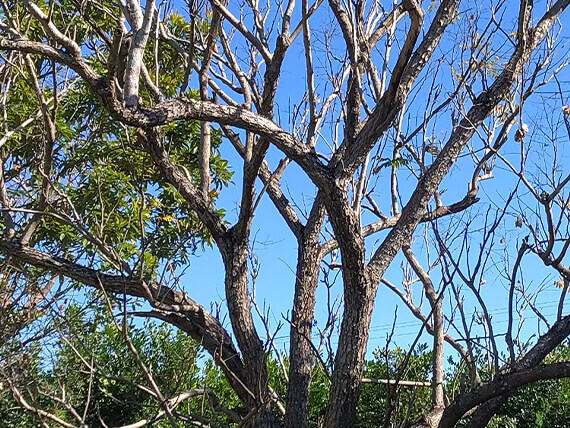
Signs that your tree may be dead or in decline
Telling if a tree is actually dead isn’t always easy. Some trees are just deciduous & lose their leaves during certain seasons every year. Some trees, although sick, can take years to actually die.
Dead trees can also stand upright for years - this doesn’t mean they’re safe or there is any sign of life in there - In fact, they could be really dangerous.
Some major signs to look for
1. No leaves or buds during the growing season
Most Australian native trees like Bottlebrush, Kurrajong, Lilly Pilly & Wattles are evergreen - meaning they generally have foliage all year round.
A deciduous tree on the other hand is a type of tree that loses its leaves each year, usually in the autumn. This seasonal shedding helps the tree conserve water and energy during colder or drier months, especially in temperate climates
Some tree species like Jacaranda and Frangipani are deciduous. They drop their leaves around winter but then burst out in flower come Spring.
If your tree doesn’t bounce back & have full foliage or flowers come Spring and Summer then this may be a sign that something is wrong.
2. Weird mushroom-like growths at the bottom
Mushroom growths at the base of a tree can be a warning sign of underlying problems such as decaying wood or Root Rot.
Many mushrooms are fungi that feed on decaying organic matter. So if they're growing at the base, it may mean the roots or lower trunk are rotting.
Fungal growth often appears after a tree is already stressed, diseased, or dying.The mushrooms are likely a symptom, not the cause.

3. Brittle or peeling bark
When a tree is in decline, you’ll often see:
- Peeling bark falling away in large strips.
- Cracks, gaps or hollow areas may also appear in the trunk.
- Brittle bark on a tree is often a sign of stress, disease, or simply age. While some minor cracking can be natural, brittle, or peeling bark (especially if it's falling off), it may indicate a deeper issue that could threaten the tree’s health or stability.
- Borers and other pests tunnel under the bark, interrupting nutrient flow and drying it out.
- Small holes, sawdust-like frass, or peeling bark.
4. No new growth or buds
The primary site where trees produce new buds and new growth is at the tips of branches. A tree that is completely unresponsive during the active growing season is a cause for concern. It may mean the tree is stressed, diseased or likely dead.
Still unsure whether your tree is actually dead?
Here’s a simple test - To check if your tree is dead or still alive, scratch a small patch of bark on the trunk or a large branch using your fingernail or a knife.
- Green and moist underneath? The tree is still alive.
- Brown, dry or brittle? That part of the tree may be dead.
You’re looking for visible signs of life; something green underneath the surface.
Test a few spots. Some branches might be dead and gone, but the rest of the tree could still be hanging on. In some cases, this could simply be a sign of the tree dying, not completely dead yet. If the trunk shows no green tissue at all, it’s likely the tree has died.
Keep the scratches small - there’s no need to remove large patches or chunks of tree.
Can I save my dead or dying tree?
If your tree is completely dead - then the answer is unfortunately no.
Once the roots, trunk and branches have completely died & there’s no living tissue left then unfortunately there’s no way to revive it.
In regards to saving a sick or dying tree, well that depends on the cause of its decline.
Having your tree assessed by a professional arborist would be the first step in potentially diagnosing the problem.
If the declining tree is able to be saved, be patient! Struggling/sick trees can take months and sometimes years to fully recover.
What should I do now?
If you have a sick or completely dead tree on your property, it's best not to wait. Dead trees may eventually drop a large limb or completely uproot and fall over. This could cause serious harm to people or damage property.
Make the call and get it checked by an expert. At Wide Bay Tree Service, we offer a comprehensive range of tree care services across the Bundaberg and Wide Bay region. Whether the tree’s dead, damaged, or in decline, we’ll inspect it thoroughly.
Our qualified arborists can tell if a tree is truly dead, or simply struggling with stress or tree diseases. They can also advise on pruning, treatment, or safe removal if needed - especially when dealing with a dying tree that hasn’t yet fully declined.
Your property and safety are of utmost importance.